
CBD Regulatory Compliance, Verification & Botanical Authentication

Laboratory technician performing CBD regulatory compliance and analytical testing on a botanical specimen in a controlled laboratory environment.

Independent laboratory analysis confirming botanical origin, cannabinoid composition, and non-cannabis classification of Kriya® Hops CBD.

All analyses performed by ISO-accredited third-party laboratories and presented without alteration.

Independent Laboratory Verification

Third-Party Botanical and Cannabinoid Analysis

Botanical identification and cannabinoid analyses for Kriya® Hops CBD were conducted by Alkemist Labs, an ISO-accredited, independent analytical laboratory specializing in botanical authentication, CBD regulatory compliance and phytochemical characterization.

Alkemist Labs performed these analyses as a third party, without involvement in cultivation, extraction, formulation, or commercialization of the material tested. The laboratory’s role was limited exclusively to analytical evaluation using established chromatographic methods.

These independent laboratory reports document:

Each report applies only to the specific sample analyzed and is presented to support CBD regulatory compliance, transparency, regulatory clarity, and scientific documentation.

Botanical Species Authentication (HPTLC)

Botanical Identification: Humulus sp. (Hops)

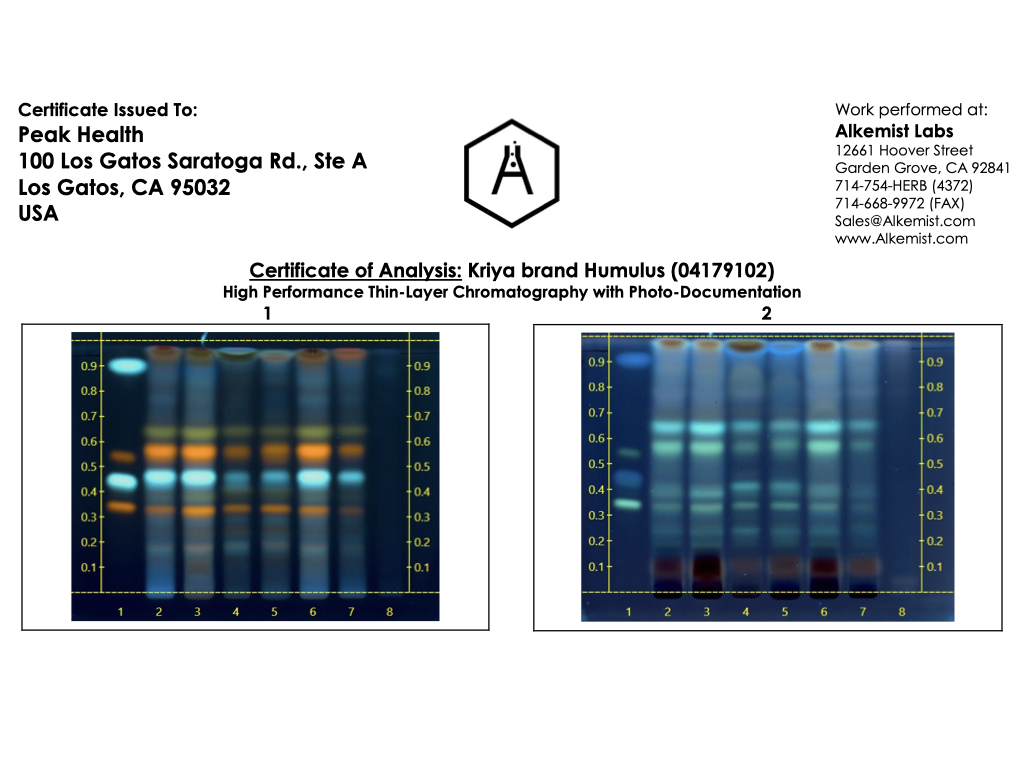
Method: High Performance Thin-Layer Chromatography

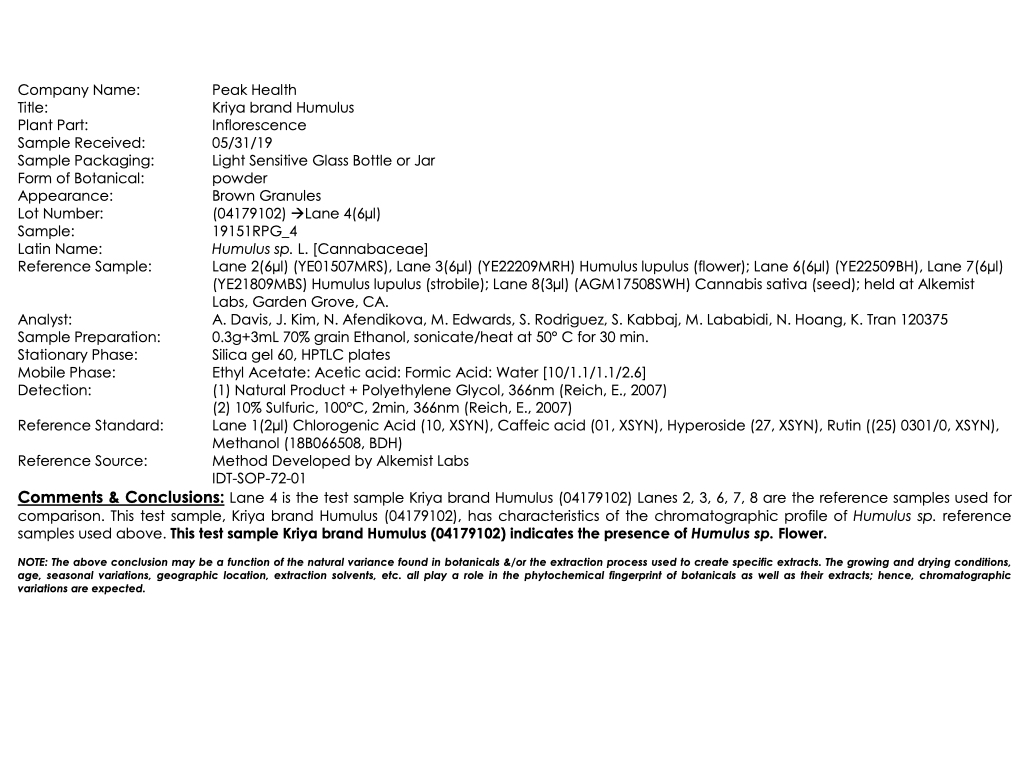
Comparison against authenticated Humulus and Cannabis references

Outcome: Chromatographic alignment with Humulus, not Cannabis

"The chromatographic profile of the Kriya® sample aligns with Humulus reference samples and is distinct from Cannabis reference material."
Dr. Cam Josephson
USDA
High performance thin-layer chromatography (HPTLC) plates comparing the chromatographic profile of a Kriya® Humulus sample with authenticated Humulus and Cannabis sativa reference materials.

Cannabinoid Analysis: CBD Present, THC Not Detected

Cannabinoid Composition (UPLC)

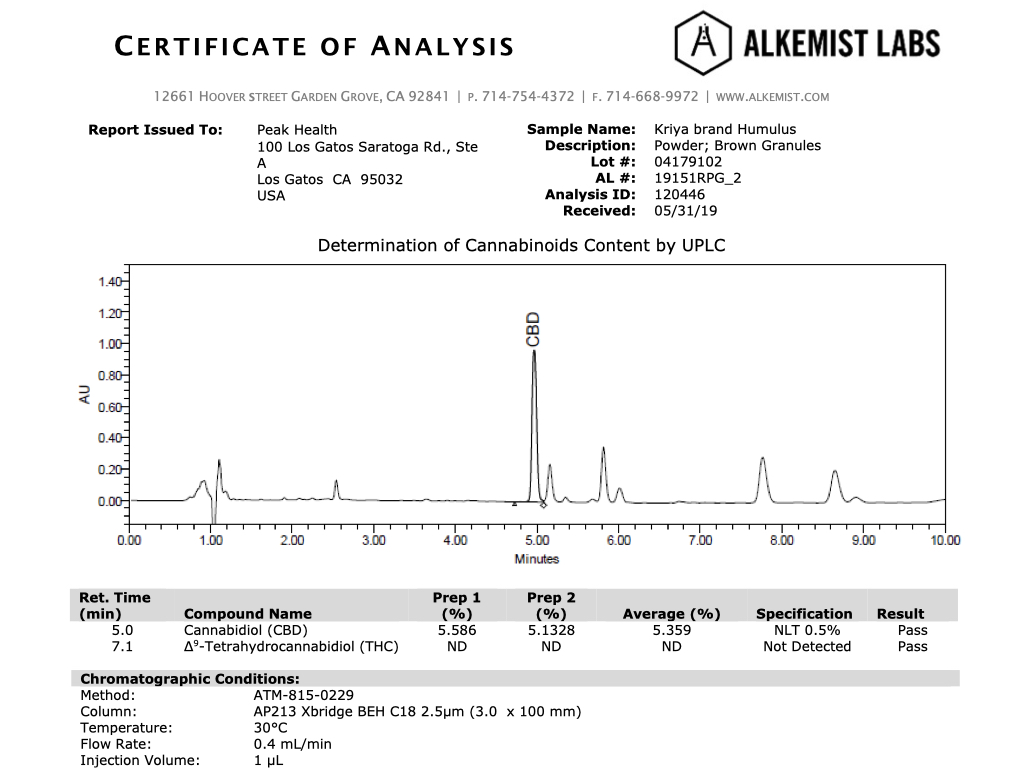
Cannabinoid composition of the Kriya® Humulus sample was determined using Ultra-Performance Liquid Chromatography (UPLC) by an independent third-party laboratory. This analytical method allows for precise separation, identification, and quantification of cannabinoids based on controlled chromatographic conditions.

The analysis identified a distinct peak corresponding to cannabidiol (CBD) at a retention time of approximately 5.0 minutes, which was quantified at 5.4% on an as-is basis. In contrast, Δ9-tetrahydrocannabinol (THC) was not detected, with no measurable peak observed at the expected THC retention time of approximately 7.1 minutes.

All analytical parameters—including column chemistry, mobile phase composition, flow rate, temperature, injection volume, and ultraviolet detection wavelength—were controlled and documented to ensure reproducibility and analytical specificity. Sample preparation and dilution were performed according to established CBD regulatory compliance and laboratory protocols prior to analysis.

Ultra-performance liquid chromatography (UPLC) chromatogram showing a cannabidiol (CBD) peak and no detectable Δ9-tetrahydrocannabinol (THC) in a Kriya® Humulus sample.

These results document the presence of cannabidiol and the absence of detectable THC in the tested sample and apply solely to the material analyzed under the reported conditions.
(Source: Alkemist Labs — UPLC Cannabinoid Analysis Report)

Regulatory Implications

Important Regulatory Distinctions

The analytical findings presented on this page support several important CBD regulatory compliance and distinctions, while remaining limited to what the underlying data directly demonstrates.

Botanical Authentication

Independent laboratory analysis establishes that Kriya® Hops CBD is not derived from Cannabis sativa. Botanical authentication using comparative chromatographic methods identifies the tested material as belonging to the Humulus genus, with a chromatographic profile distinct from cannabis and hemp reference samples. This botanical identity is based on species-level analysis and is not an inference drawn from cannabinoid content alone.

CBD Present, THC Absent

Cannabinoid analysis further demonstrates the presence of cannabidiol (CBD) and the absence of detectable Δ9-tetrahydrocannabinol (THC) under the reported analytical conditions. The absence of THC is an analytical finding, not a presumption, and applies specifically to the tested sample using validated chromatographic methods and defined detection parameters.

Applicable Laws

Regulatory classification of botanical materials and ingredients may vary by jurisdiction and is determined by applicable laws, regulations, and agency guidance. While regulatory treatment can differ across regions, the botanical identity and cannabinoid composition of the analyzed material are unambiguous based on independent laboratory evidence.

FSSAI License No. 10018025000320

In addition to third-party analytical verification, Kriya® Hops–derived material has been reviewed and accepted for use as a food ingredient by the Food Safety and Standards Authority of India (FSSAI) under FSSAI License No. 10018025000320. This approval reflects regulatory recognition of the ingredient within the applicable food safety framework in India and is specific to the conditions and scope defined by that authority.

Avoiding Assumptions

Together, these findings support transparency in botanical sourcing, chemical composition, and regulatory positioning, while avoiding assumptions or claims beyond what the analytical data and regulatory records substantiate.